Interview with Katie for Tourette’s Awareness Month
We recently chatted to Katie, who works at Coastland College. The College is keen to raise awareness during Tourette’s Awareness Month by showing the film 'I Swear' to its students and creating an awareness board to help dispel some of the myths around Tourette's.
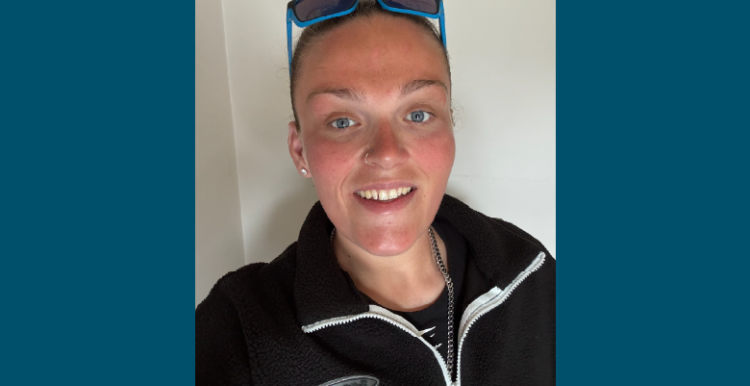
Please tell us a little bit about yourself and the work that you do?
"My name is Katie and I live with Tourette syndrome. I've displayed certain tics for many years, but I was only diagnosed in 2022 with Tourette's.
"My job is SEN (Special Educational Needs) Administrator at Coastland College (formerly known as Weymouth College). I started as an LSA, which is a Learning Support Assistant, however my tics became bad and I had to transfer to an admin role to suit me and the students better.
"I've worked at the college for nearly five years."
To help people understand, how does having Tourette’s impact your day-to-day life?
"Well, every single day looks very different for me. Some days, you wouldn't really know I had Tourette syndrome. Some days I just have facial tics, and on other days I can't even carry out basic day-to-day tasks such as brushing my teeth without supervision. There have been many days that I have nearly put toothpaste in my eye just from ticking, and nine times out of 10, I can't even make a cup of tea. This is the reality that people don't see with Tourette's."
Why do you believe it's important to celebrate Tourette's Awareness Month?
"I feel it's important to celebrate Tourette's Awareness Month because there is too much stigma around Tourette syndrome and what it actually is. Tourette's is viewed as a condition where people just swear, which is actually called Coprolalia, and only affects 10-15% of people with Tourette syndrome. Coprolalia is the part of Tourette's which causes people to swear and shout absurd obscenities, but that is a rare part of Tourette syndrome. Tourette's isn't a rare condition; the Coprolalia part of Tourette's is the rare part.
"I think it's really important to raise awareness about Tourette syndrome, especially throughout Tourette's Awareness Month, because it's not actually as rare as people think it is."
What can we do to challenge the social stigma of Tourette’s and promote a more accurate understanding of the condition?
"As a society, we can help people with Tourette's and create a more truthful, accurate awareness by sharing real stories of the day-to-day life of people who are living with Tourette syndrome."
What do you think health and social care services can do differently to better support people with Tourette’s?
"For me personally, I feel health and social care services need more training, understanding, awareness and education on Tourette syndrome. Myself, and the people who support me, such as my friends and family, have been told many times by the NHS that they have little to no knowledge of Tourette syndrome. They don't know what to do, especially during times when I've had severe tic attacks and the medication that brings me out of my attacks hasn’t worked. They just don't have a clue what to do when I'm having bad tic attacks.
"I also feel that there's a lack of support for the people who support me, if that makes sense. There’s not a lot of support available for my family and my friends.
"I do have a brilliant neurologist, based in Exeter, that I have to travel to see, but there’s not really anyone locally who can support me, my family and my friends."
If you are having a ‘high-tic’ day, what do you feel is the best way for a friend or colleague to support you?
"Again, this is personal to me, but if I'm having a high tic day, I tend to stay in a low, quiet and unstimulated area, so I can feel safe. I make sure I have my PRN (pro re nata) medication (lorazepam/diazepam/clonazepam) because if I go into a tic attack, I need to take my medication. I often need help with that, so I call my partner or my family. The medication helps my body relax and slow down, so my muscles stop spasming.
"The people closest to me basically try and ignore my tics, unless I'm going to cause harm to myself or others. Personally, I don't tend to cause harm to others. I just tend to be aggressive towards myself."
What is something that you wish more people understood about living with Tourette’s?
"The main thing that really does upset me is that people think the vocal tics are what I'm thinking, and that is not true. The vocal tics aren't what I'm thinking.
"The attacks are also really painful, which people don’t realise. Most of the time, the attacks happen in the evening or when I get into bed. I've had some attacks that last 11 hours, and I've had some that just last for an hour. My whole body is ticking and I can't stop it. They're exhausting, they're painful, and my whole body hurts for days afterwards. For me personally, my tic pain causes my tics to increase, so it's like a vicious cycle. I then feel like I have a hangover for a couple of days afterwards.
"One thing I really wish people would understand is the reality of living with Tourette syndrome."
Tourettes Action can be contacted for support. It is the leading UK support charity for people with Tourette syndrome and their families.
Share your story
Get in touch to share your experiences of local health and social care services, good and bad, to help make care better for all Dorset residents.